



This article explains what an MV cable is, where engineers use it, and why it plays a critical role in modern electrical and renewable energy systems. You will learn how professionals design, select, and manage MV cables to ensure safety, reliability, and compliance.
What is an MV Cable?
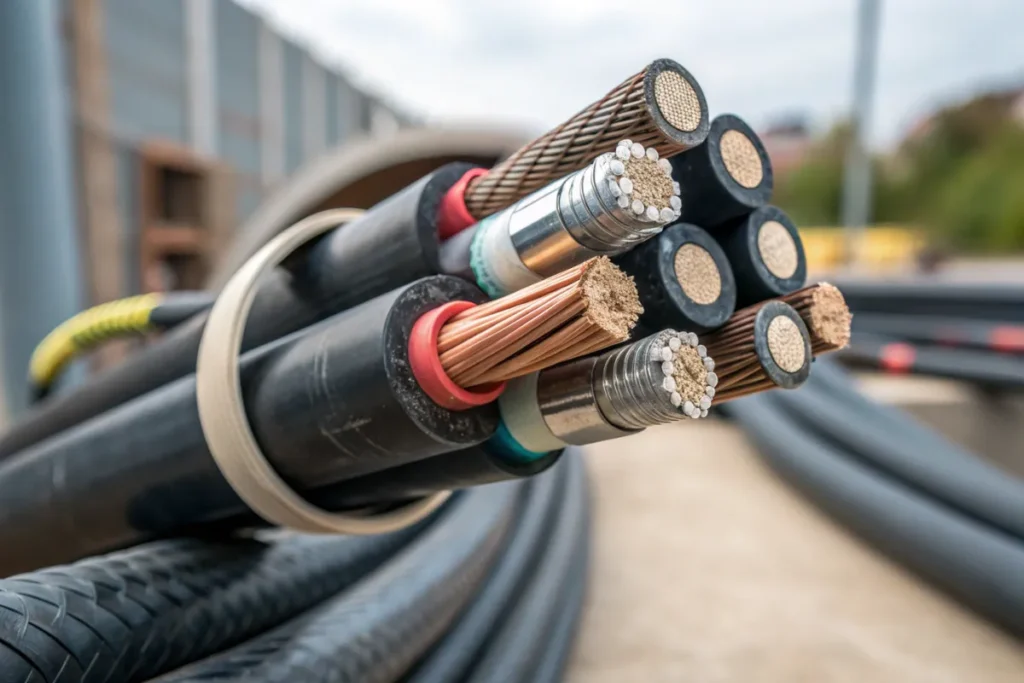
An MV cable operates at medium voltage levels, typically between 1 kV and 36 kV, and transmits and distributes electrical power.
MV cables exist to efficiently transport electrical power over moderate distances while balancing insulation complexity, losses, and cost. Low voltage cables become impractical at higher power levels due to excessive current and losses, while high voltage systems introduce higher insulation, clearance, and protection requirements. MV cables provide an optimal technical compromise for feeders, renewable plants, industrial facilities, and substations.
MV cables are used whenever power must be transferred between substations, generation assets, and large loads without stepping up to transmission voltage. In renewable energy systems, they connect inverters to collection networks and substations, making their electrical, thermal, and mechanical performance critical for long term system reliability.
Technical Causes and Factors of MV cable
The design and selection of MV cables are driven by several technical factors.
- Nominal voltage and insulation requirements
- Current carrying capacity and thermal limits
- Installation method such as underground or overhead
- Soil thermal resistivity for buried cables
- Short circuit withstand capability
- Environmental exposure including moisture and chemicals
MV Cable Types
XLPE Insulated MV Cables
Engineers most widely use cross linked polyethylene insulated cables because they deliver high thermal performance, low dielectric losses, and long service life.
EPR Insulated MV Cables
Ethylene propylene rubber insulated cables offer superior flexibility, and engineers often select them for harsh environments or applications with high mechanical stress.
Armored MV Cables
Armored cables include metallic protection layers to withstand mechanical impact, rodent damage, and higher installation stresses.
MV Cables for Underground Installation
Designers engineer these cables to dissipate heat through the soil and must carefully consider trench design and soil properties.
MV Cables for Renewable Energy Systems
Used in solar and wind plants, these cables must handle cyclic loading, harmonics, and challenging outdoor conditions.
Problem Context for Industry Professionals
MV cables represent a significant technical and financial component of power projects. Incorrect sizing, poor installation, or underestimated thermal conditions can lead to overheating, insulation failure, or reduced lifespan. In renewable projects, cable losses and failures directly impact energy yield and operational availability.
Engineers also face challenges related to evolving standards, grid code requirements, and coordination with protection systems. Repairing or replacing MV cables is costly and disruptive, making early design accuracy essential.
Solutions and Professional Best Practices
Professionals can mitigate MV cable risks by integrating cable engineering early in the design phase. Accurate load calculations, derating assessments, and short circuit studies are essential to avoid overstressing the cable system.
Key best practices include
- Applying correct thermal and installation derating factors
- Selecting insulation and armor based on site conditions
- Performing soil thermal studies for underground routes
- Coordinating protection settings with cable limits
- Using digital modeling tools to validate current and loss assumptions
By transitioning to data driven cable design and verification, professionals can reduce failures, optimize costs, and ensure long term system performance.